

Repairing the shielding of glass tubes.
This is an excerpt from an article written in Dutch by Mr
W. BREIJ and published in Radio Historisch Tijdschrift, the magazine of the
Nederlandse Vereniging voor de Historie van de Radio.
The zinc coating covering old tubes and serving as a shield is generally in poor condition or has almost completely disappeared. Furthermore, the copper wire connecting the tube base to the shielding is often broken and therefore no longer provides good contact with the cathode.
To remedy this situation, we need the following materials:
First check that the glass section and the tube base are firmly attached to each other. If not, degrease the joint using a cotton swab soaked in acetone. Use as little adhesive as possible.
First, the copper wire located in the joint must be exposed by carefully bending it outwards without breaking it.
Remove the old shielding layer using a wooden scraper. Do not use metal, as it could scratch the glass. Even the slightest scratch could cause the tube to shatter. If necessary, use paint stripper. Allow it to work, then clean the surface with the wooden scraper. Do not forget to wear gloves.
Next, rinse the glass thoroughly with lukewarm water (but not the base!).
Carefully put the copper wire back into the recess between the glass and the tube base.
Then spray a layer of graphite onto the glass from a distance of 25 cm, applying it very regularly and evenly. Make sure that the joint is completely covered. Then leave it to dry in a warm place for at least one hour to prevent blistering. Once dry, check that the coating is uniform; if not, repeat the operation.
Apply the paint in the same way as the graphite, taking the same precautions. Apply the paint evenly in thin coats and allow it to dry thoroughly between applications.
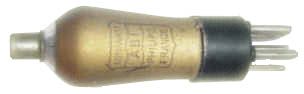
Silver paint for Telefunken, Gold paint for Philips Miniwatt
Once the paint is dry, you can transfer the letters and numbers onto the tube and complete the operation by applying a coat of No. 70 plastic varnish over the painted section.
Do not forget to transfer the special symbols as well, for example the large 'O' found on the Telefunken RENS 1264, which indicates the purpose for which the tube is intended. A large 'O' means that the tube is used as a mixer, while a small 'o' means that it is used in less critical circuits.
The zinc coating covering old tubes and serving as a shield is generally in poor condition or has almost completely disappeared. Furthermore, the copper wire connecting the tube base to the shielding is often broken and therefore no longer provides good contact with the cathode.
To remedy this situation, we need the following materials:
- 1 can of fine graphite spray (No. 33 from Kontakt Chemie, for example)
- 1 can of insulating plastic spray (Plastic No. 70 from Kontakt Chemie)
- 1 can of gold, silver or red automotive lacquer, depending on the type of tube being treated.
- Plastic gloves
- Masking tape
- Self-adhesive letters and numbers (available from stationery shops)
- Paint stripper.
- Cyanoacrylate adhesive for reattaching the bases.
First check that the glass section and the tube base are firmly attached to each other. If not, degrease the joint using a cotton swab soaked in acetone. Use as little adhesive as possible.
First, the copper wire located in the joint must be exposed by carefully bending it outwards without breaking it.
Remove the old shielding layer using a wooden scraper. Do not use metal, as it could scratch the glass. Even the slightest scratch could cause the tube to shatter. If necessary, use paint stripper. Allow it to work, then clean the surface with the wooden scraper. Do not forget to wear gloves.
Next, rinse the glass thoroughly with lukewarm water (but not the base!).
Carefully put the copper wire back into the recess between the glass and the tube base.
Then spray a layer of graphite onto the glass from a distance of 25 cm, applying it very regularly and evenly. Make sure that the joint is completely covered. Then leave it to dry in a warm place for at least one hour to prevent blistering. Once dry, check that the coating is uniform; if not, repeat the operation.
Apply the paint in the same way as the graphite, taking the same precautions. Apply the paint evenly in thin coats and allow it to dry thoroughly between applications.
Silver paint for Telefunken, Gold paint for Philips Miniwatt
Once the paint is dry, you can transfer the letters and numbers onto the tube and complete the operation by applying a coat of No. 70 plastic varnish over the painted section.
Do not forget to transfer the special symbols as well, for example the large 'O' found on the Telefunken RENS 1264, which indicates the purpose for which the tube is intended. A large 'O' means that the tube is used as a mixer, while a small 'o' means that it is used in less critical circuits.
